Choosing a wood drying system can shape product quality, energy use, and production schedules. Wood Drying Equipment ranges from conventional kiln systems to heat-pump and vacuum solutions. Each approach handles moisture differently. The right choice depends on species, board thickness, target moisture content, available space, and local energy costs. Details matter.
This guide introduces ten manufacturers serving the wood-drying market in China. It gives buyers a starting point, not a universal ranking. Company capabilities, product specifications, and service coverage can change, so verify current information directly with each supplier. Ask for kiln capacity, temperature controls, insulation details, and moisture-monitoring methods. Request operating references for materials similar to yours. A brochure is not proof of performance.
Practical evaluation should include installation support, spare-parts access, operator training, and expected maintenance. A kiln may look efficient on paper but perform differently under a real production load. That distinction is easy to miss. Compare quotations using the same drying requirements and check what each offer includes. Consider sample tests where feasible, especially for valuable or difficult-to-dry timber. There is no perfect shortlist for every factory. The manufacturers below are presented to support informed research, while final decisions should reflect measured needs and independently checked claims.
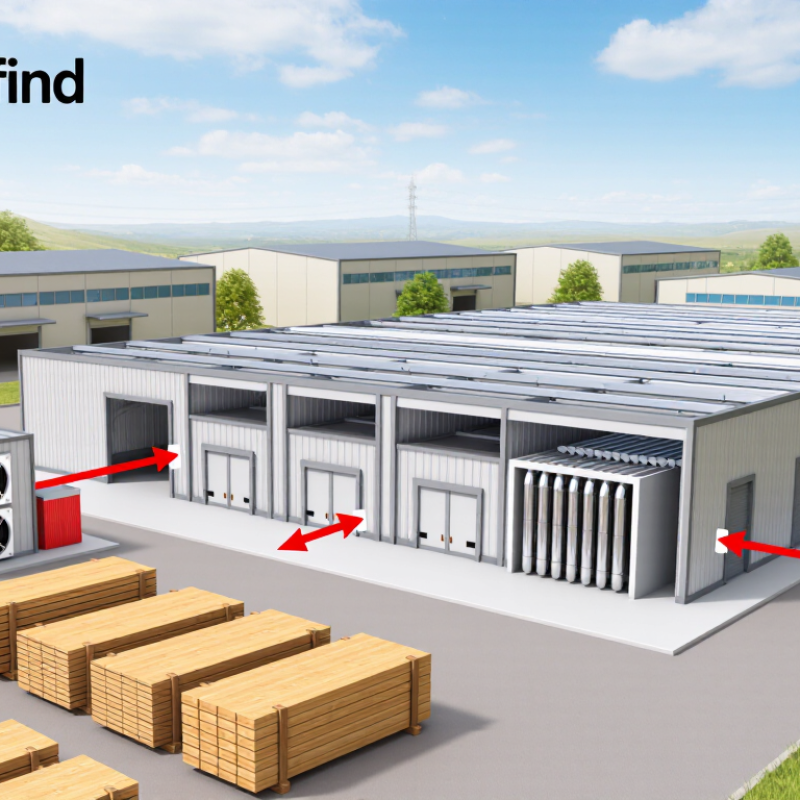
Wood drying equipment removes excess moisture from freshly sawn timber under controlled conditions. In a kiln, fans move warm air between stacked boards, while vents and sensors help regulate temperature and humidity. Operators monitor moisture readings, because the outside of a board can dry faster than its core. That difference matters. If drying moves too quickly, timber may develop checks, warping, or internal stress.
A suitable drying schedule depends on wood species, board thickness, and the timber’s intended use. Furniture stock may need a different final moisture level from framing lumber used indoors. Careful stacking with evenly spaced stickers helps air reach each board; blocked airflow can leave damp patches. Equipment also supports repeatable processing, but it cannot correct poor loading or inaccurate measurements. In practice, schedules are not perfectly tidy: operators may need to adjust them when readings drift or conditions change. That takes judgment. Regular checks of fans, sensors, seals, and heating components can help maintain consistent results and avoid needless energy use.
China’s wood-Drying Equipment industry has shifted from basic hot-air kilns toward systems that managetemperature, humidity, and airflow more precisely. The change reflects a larger, more demanding wood-processing sector. China’s National Forestry and Grassland Administration reported wood-based panel production of about 343 million cubic metres in 2023. That scale puts pressure on mills to dry timber and residues consistently, not just quickly. A stack of boards can look uniform from the aisle and still hold uneven moisture at its centre.
Manufacturers have responded with kiln controls, heat-recovery options, and monitoring tools that help reduce drying defects and energy waste. The direction matches the International Energy Agency’s broader finding that industrial efficiency depends on better process control and waste-heat recovery. Yet adoption is uneven: smaller plants may lack the technicians or investment needed to operate advanced systems well. More sensors do not automatically mean better drying. Operators still need to understand species, board thickness, and target moisture content. In practice, a reliable moisture reading can matter more than a polished control screen. Progress is real, but it is not neat.
Choosing a wood drying equipment manufacturer in China requires more than comparing quoted prices. Start with the intended wood species, board thickness, starting moisture, and target moisture content. A supplier should explain how its chamber design and control system address those conditions. Ask for operating data from comparable installations, not only a polished brochure. Details matter.
Inspect the technical proposal for airflow direction, fan capacity, heating method, insulation, and sensor placement. Ask how temperature and humidity are measured across the load. In a well-designed kiln, boards near the door should not dry very differently from those at the center. Request a sample drying schedule and clarify whether it can be adjusted for seasonal changes or different timber. A schedule is not a guarantee; actual results depend on loading and operation.
Evaluate manufacturing quality through drawings, component specifications, inspection records, and a clear warranty scope. If possible, review a working installation or speak with a customer using similar wood. Ask who handles commissioning, operator training, spare parts, and remote troubleshooting. These practical points can affect downtime as much as the equipment itself. Be cautious when a proposal promises unusually short drying times without stating the wood conditions. Even careful buyers may overlook service response times; I would put those commitments in writing.
China’s top 10 wood drying equipment manufacturers are best compared by capability, not ranking alone. The FAO’s Global Forest Products Facts and Figures 2022 reports global sawnwood production of roughly 444 million cubic metres. That scale keeps demand for dependable drying systems tied to furniture, construction, and panel production. Yet output figures do not reveal which kiln suits a particular mill.
At a glance, Chinese suppliers span conventional steam kilns, dehumidification systems, and vacuum dryers. Compare usable chamber volume, stated moisture uniformity, heat-source options, and control accuracy. Ask for operating data from timber similar to yours, not only catalogue capacity. A thick hardwood load behaves differently from thin softwood boards. Small details matter. Check sensor placement, door sealing, airflow paths, and access for maintenance. The International Energy Agency’s tracking reports identify industrial efficiency as an important route to lower energy demand, but kiln performance depends on loading and operation as much as equipment design. Request measured energy use per cubic metre and drying-cycle records. Some claims remain difficult to compare. That is worth admitting. A concise shortlist should therefore separate verified test results from manufacturer estimates and consider local service availability before purchase.
China’s top ten wood drying equipment manufacturers differ mainly in process control, chamber design, and target timber. Conventional steam kilns remain suitable for large sawmills needing stable batch production. Vacuum kilns reduce drying time and handle thick hardwood more gently, but their pumps and seals demand closer maintenance. Dehumidification kilns recover heat efficiently, making them attractive for smaller factories and energy-conscious operations. Solar-assisted systems can lower operating costs, although weather still affects output.
The USDA Forest Products Laboratory’s Wood Handbook commonly places indoor furniture timber near 6–8% moisture content. That target requires accurate sensors, airflow control, and uniform stacking. The FAO’s 2023 forestry statistics report shows global sawnwood production exceeding 450 million cubic metres in 2022. This scale explains the demand for high-capacity chambers, automated loading, and continuous moisture monitoring. Yet capacity alone is misleading. A 100-cubic-metre kiln may perform poorly with mixed species or uneven board thickness. Manufacturer specialties therefore matter: some focus on hardwood schedules, some on high-temperature softwood drying, and others on compact systems for custom workshops.
Independent testing should examine drying uniformity, energy use per cubic metre, cycle records, and after-sales response. Those details reveal more than catalogue output. I would also question impressive energy claims without a stated wood species and starting moisture level. Real factories are rarely perfect. Door leakage, overloaded fans, and inconsistent stacking can weaken otherwise advanced equipment.