
China’s ceramic industry is no longer defined only by large-scale production. It now competes through material purity, dimensional control, and application-specific engineering. That shift matters when evaluating Ceramic Rod manufacturers for furnaces, sensors, electrical insulation, laboratory equipment, and wear-resistant assemblies.
Grand View Research valued the global advanced ceramics market at approximately USD 11.8 billion in 2023. It forecasts a compound annual growth rate of about 5.5% through 2030. MarketsandMarkets presents a similar outlook, estimating growth from nearly USD 11.8 billion in 2024 to USD 14.6 billion by 2029. These reports do not isolate ceramic rods. That limitation deserves attention. Rod demand can vary sharply across alumina, zirconia, silicon nitride, and steatite applications.
C. Barry Carter, a leading ceramic materials scholar and coauthor of Ceramic Materials: Science and Engineering, wrote, “Ceramics are inorganic, nonmetallic materials.” His concise definition supports a practical point: composition and processing control performance. A rod with 99.5% alumina may suit electrical insulation, while zirconia may better resist fracture and thermal shock. Numbers alone are not enough.
A reliable comparison should examine raw-material certificates, sintering consistency, straightness, surface finish, tolerance data, and production traceability. Factory photographs can show polished white rods, but they cannot prove batch stability. That is where many rankings become too confident. Supplier audits, sample testing, and application trials remain essential.
This guide compares leading China Ceramic Rod manufacturers through those measurable factors. It also considers export experience, customization capability, technical communication, and documented quality systems. Not every large factory is the best fit. The right choice depends on operating temperature, mechanical load, electrical requirements, and delivery risk.
What Are Ceramic Rods and Where Are They Used?
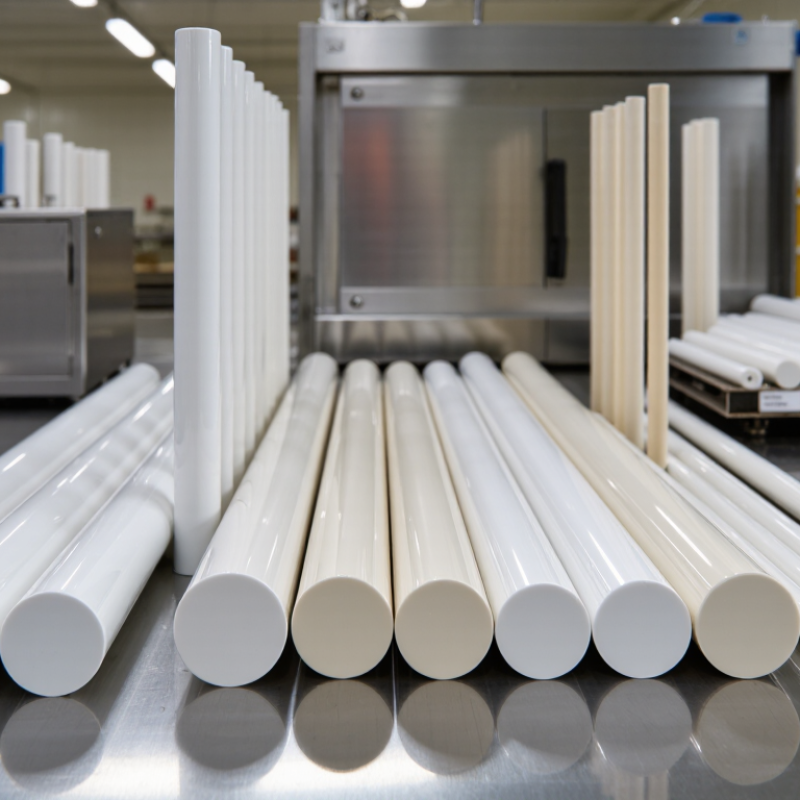
Ceramic rods are solid cylindrical components made from technical ceramics. Common materials include alumina, zirconia, silicon nitride, and silicon carbide. They resist heat, abrasion, corrosion, and electrical current better than many metals. Alumina rods are widely used for furnace supports, electrical insulation, laboratory fixtures, and wear-resistant guides. Zirconia offers higher toughness, making it suitable for precision shafts and valve parts.
According to Grand View Research, the global advanced ceramics market was valued at approximately USD 11.5 billion in 2023. The report also forecasts continued growth through 2030, driven by electronics, energy, medical equipment, and industrial automation. The U.S. Geological Survey’s 2024 Mineral Commodity Summaries reported global bauxite production above 390 million metric tons in 2023. This matters because alumina feedstock supports many ceramic products. Still, a market forecast is not a product guarantee. It can sound more certain than reality.
Tips: When comparing Chinese ceramic rod manufacturers, request density, hardness, thermal-expansion, and dielectric-strength data. Ask for batch inspection records and dimensional tolerances. Check whether the rod has ground, polished, or as-fired surfaces. A tiny diameter error can affect assembly alignment. Price alone is a weak test. I would also review sample performance under actual temperature and load conditions, because catalog values may not reflect field use.
A reliable China ceramic rod manufacturer proves quality through consistent evidence, not attractive claims. Experienced buyers should review material grades, dimensional tolerances, surface roughness, and operating temperature data. Alumina, zirconia, and silicon nitride rods behave differently under heat, pressure, and chemical exposure. Details matter. A dependable supplier explains these differences clearly and recommends a suitable grade for the application.
Ask for recent inspection reports, batch traceability, and production records. A serious manufacturer should provide measurable results, such as diameter tolerance, straightness, density, and flexural strength. Request samples before placing a large order. Samples reveal flaws. Check the rod under magnification for chips, cracks, uneven glazing, or rough ends. Packaging also matters, especially when thin rods travel long distances. Some suppliers communicate well before payment, then respond slowly after production begins. That warning deserves attention.
Tips: Compare at least three suppliers using the same technical requirements. Confirm whether testing occurs in-house or through an independent laboratory. Ask how rejected pieces are controlled. Keep drawings, approval samples, and inspection criteria in writing. A certificate alone is not enough. Review its date, testing method, and matching batch number. Reliability is built through repeatable processes, transparent communication, and honest answers about limitations. A minor uncertainty should not be ignored; it may become a costly failure later.
Comparing China’s leading ceramic rod manufacturers requires more than checking price lists. Start with the material grade, diameter tolerance, straightness, surface finish, and operating temperature. Alumina rods suit electrical insulation and wear resistance, while zirconia offers higher toughness. Ask for measured data, not general claims. A reliable manufacturer should provide inspection records, batch traceability, and clear production tolerances.
Request samples from several factories and test them under realistic conditions. Check whether a 10 mm rod remains stable after heating, cooling, machining, or repeated loading. Review the manufacturer’s equipment, quality-control process, and experience with similar applications. Certifications can support credibility, but they should not replace independent testing. A polished catalog is not proof. Even careful buyers can overlook packaging damage or small surface cracks.
Tips: Compare response speed, technical questions, sample consistency, and corrective-action records. Ask how rejected batches are handled. Confirm export documents and delivery terms in writing. Do not select the lowest quotation automatically; inconsistent rods may create higher machining and replacement costs.
My view is imperfect: a strong sample does not guarantee every future batch. Use a written specification and approve production samples before ordering.
Choosing a ceramic rod manufacturer requires more than comparing prices or catalogue dimensions. The critical test is process control, material traceability, and application evidence. China has a broad technical-ceramics supply base, but capabilities vary sharply between factories.
Alumina rods suit electrical insulation, wear resistance, and moderate thermal loads. The USGS Mineral Commodity Summaries 2024 reported global alumina production at approximately 141 million metric tons in 2023, showing the material’s industrial scale. Zirconia offers higher fracture toughness, while silicon nitride performs well under thermal shock and demanding mechanical stress.
The right manufacturer should control powder purity, pressing, extrusion, sintering, grinding, and dimensional inspection. Ask for density, hardness, porosity, dielectric strength, and thermal-expansion data. Certificates alone are not enough.
Tips: Request sample rods from the same production route used for volume orders. Check diameter tolerance, surface roughness, chamfer quality, and straightness under actual inspection conditions. ISO 9001 certification can support process discipline, but it does not prove every ceramic grade performs equally. Ask for batch-level test records and independent laboratory results when failure costs are high.
Manufacturers with hot isostatic pressing, precision centerless grinding, and controlled sintering usually offer stronger consistency. Yet “higher purity” is not automatically better. A 99.5% alumina rod may outperform a 99.9% grade when geometry, cost, and thermal conditions match the design. This is where buyer experience matters. I would avoid selecting from marketing claims alone; real application testing often exposes assumptions that look convincing on paper.
Choosing the right China ceramic rod supplier requires more than comparing unit prices. Grand View Research valued the global advanced ceramics market at approximately USD 11.8 billion in 2023, with continued growth expected through 2030. This expansion attracts capable factories and inexperienced traders. A polished brochure is not proof.
Start with the material and application. Ask whether the rod is alumina, zirconia, silicon nitride, or another ceramic. Request test data for density, flexural strength, hardness, thermal shock, and electrical insulation. Confirm dimensional tolerances and surface roughness in writing. For a 10 mm rod, a small diameter error can affect assembly pressure and wear. It matters.
Reliable suppliers should provide batch traceability, inspection records, and relevant quality certifications. ISO 9001 certification supports process control, but it does not guarantee perfect products. Ask for recent certificates, not screenshots. Request samples from the same production route used for mass orders. Independent testing can verify purity and strength. It adds cost, but prevents expensive surprises.
Review production capacity carefully. Can the supplier maintain straightness after sintering and grinding? Can it control packaging against chips, moisture, and impact? MarketsandMarkets identifies electronics, medical equipment, and industrial applications as major advanced ceramics demand areas, each requiring different specifications. Therefore, evaluate technical communication, response accuracy, and corrective-action records. Do not judge only by the lowest quotation. My own preferred checklist remains imperfect: it may miss hidden furnace variation, so periodic inspection is still necessary.
The table below provides an objective comparison framework based on commonly used ceramic rod materials, manufacturing capabilities, quality documentation, and purchasing criteria. Property values are typical industry ranges and should be confirmed against the supplier’s technical data sheet and inspection report.
| Evaluation Dimension | Ceramic Rod Option | Typical Technical Data | Suitable Applications | Supplier Evidence to Request |
|---|---|---|---|---|
| Material composition | High-purity alumina | Al2O3: typically 95%–99.8%; density: approximately 3.6–3.95 g/cm³ | Electrical insulation, wear components, furnace fixtures, sensor supports | Material grade, chemical composition report, density test result, batch traceability |
| Material composition | Partially stabilized zirconia | Common grades: 3 mol%–8 mol% yttria-stabilized zirconia; density: approximately 5.9–6.1 g/cm³ | High-wear guides, plungers, precision shafts, cutting and forming components | Stabilizer content, phase composition, fracture toughness, hardness, dimensional report |
| Material composition | Silicon nitride | Density: typically 3.1–3.3 g/cm³; high thermal-shock resistance and low thermal expansion | High-temperature bearings, thermocouple protection, furnace and semiconductor equipment | Phase composition, porosity, thermal-shock test method, high-temperature strength data |
| Material composition | Silicon carbide | Density: commonly 3.0–3.2 g/cm³; excellent thermal conductivity and high-temperature stability | Kiln supports, heating-system components, heat exchangers, high-temperature fixtures | Silicon carbide content, open porosity, thermal conductivity, oxidation-resistance data |
| Dimensional capability | Precision-ground ceramic rod | Diameter and length tolerances depend on size, material, grinding method, and drawing requirements | Rotating assemblies, optical equipment, metering systems, precision fixtures | Signed engineering drawing, actual measurement data, roundness, straightness, cylindricity, and surface roughness results |
| Surface finish | Ground, polished, or as-fired surface | Surface roughness must be specified by the purchase drawing; polished surfaces generally require additional grinding or lapping | Sealing surfaces, sliding contacts, optical mounts, laboratory instruments | Surface-roughness measurement method, visual inspection standard, sample photos, defect limits |
| Temperature performance | High-temperature ceramic rod | Alumina, silicon carbide, and silicon nitride can be used at elevated temperatures; the actual limit depends on atmosphere, load, geometry, and grade | Heat-treatment equipment, furnaces, burners, thermocouple assemblies | Recommended operating temperature, atmosphere limitations, thermal-cycle data, load conditions |
| Electrical performance | Electrical-insulating ceramic rod | Insulation resistance and dielectric strength vary with alumina purity, porosity, temperature, frequency, and humidity | Insulators, electrical feedthroughs, ignition systems, high-voltage assemblies | Dielectric-strength test voltage, insulation-resistance test conditions, applicable electrical standard |
| Customization capability | Custom-shaped or stepped rod | Possible features include holes, grooves, threads, tapers, shoulders, slots, chamfers, and metallized areas | OEM assemblies, sensors, medical equipment, automation, laboratory devices | DFM review, prototype schedule, tooling charges, first-article inspection, engineering-change process |
| Quality management | Production and inspection system | A documented quality system should control raw materials, forming, sintering, machining, inspection, packaging, and nonconforming products | All industrial applications, especially safety-critical or high-volume products | Valid quality certification, process flow chart, control plan, inspection equipment list, corrective-action records |
| Compliance documentation | Regulated-market supply | Compliance requirements depend on product use, destination market, material composition, and contact conditions | Electrical products, laboratory equipment, industrial machinery, export projects | Declaration of conformity where applicable, restricted-substance information, material safety data, origin and traceability records |
| Packaging and logistics | Fragile ceramic rod shipment | Ceramic rods require protection against impact, bending loads, moisture contamination, and mixed-batch handling during transport | Domestic and international shipments, small batches, long-distance sea or air freight | Packaging specification, drop-test or packaging-validation records, carton labeling, spare quantity, export experience |